
New vs Old Tax Regime Under Income Tax Act 2025: Tax Year 2026-27 Guide
At a Glance
Most salaried employees fill in the tax regime declaration every April without giving it much thought — usually because the new regime is the default and switching feels like extra paperwork. But Tax Year 2026-27 is the first full year governed by the Income Tax Act 2025, and the section numbers behind that declaration have changed even though the underlying choice has not. This guide explains what the new Section 202 regime and the optional old regime actually offer, and how to work out which one leaves more money in your pocket.
Tax Year 2026-27 runs from 1st April 2026 to 31st March 2027 and is the first full tax year governed entirely by the Income Tax Act, 2025, which received Presidential assent on 21st August 2025 and replaced the Income Tax Act, 1961 with effect from 1st April 2026. For most taxpayers, the practical choice they have made every year since FY 2023-24 — new regime or old regime — remains exactly the same. What has changed is the legal address of that choice: Section 115BAC is now Section 202, the Section 87A rebate is now Section 156, and popular deductions such as Section 80C and Section 80D have been renumbered as Section 123 and Section 126 respectively.
This matters because payroll software and tax portals will increasingly reference the new numbering for Tax Year 2026-27 filings, even though the return for FY 2025-26 (filed in mid-2026) still uses the old Act 1961 numbers, and Tax Year 2026-27 returns will only be filed from July 2027 onwards. The core economic choice remains unchanged: the new regime offers lower slabs and a larger standard deduction but blocks almost every Chapter VI-A deduction, while the old regime retains higher slabs but rewards taxpayers who invest in Section 123-type instruments, pay home loan interest, or claim HRA.
Key Takeaways
• The new tax regime under Section 202 of the Income Tax Act 2025 is the default regime for Tax Year 2026-27; taxpayers who want the old regime must actively opt for it.
• Section 156 of the Income Tax Act 2025 (earlier Section 87A) gives a rebate of up to ₹60,000, making income up to ₹12 lakh effectively tax-free under the new regime, and up to ₹12.75 lakh for salaried taxpayers after the ₹75,000 standard deduction.
• The old regime standard deduction remains ₹50,000, and its Section 156 rebate (earlier Section 87A) is capped at ₹12,500 for income up to ₹5 lakh.
• Section 80C, 80D and 80CCD(1B) have been renumbered as Section 123, Section 126 and Section 124 respectively; the deduction limits themselves are unchanged.
• Salaried employees without business or professional income can switch between the two regimes every year; those with business or professional income can switch back to the old regime only once in their lifetime.
• The regime choice for Tax Year 2026-27 is exercised through the return of income filed under Section 263(1), as prescribed by Rule 136 of the Income Tax Rules 2026, rather than through a separate form.
• There is no single “better” regime — the right choice depends on how much a taxpayer actually claims under HRA, home loan interest, and Chapter VI-A style deductions each year.
What Changes When Tax Year 2026-27 Replaces Assessment Year 2026-27?
The Income Tax Act, 2025 replaces "previous year" and "assessment year" with a single concept: the "tax year," running concurrently with the financial year in which income is earned. Tax Year 2026-27 covers income earned between 1st April 2026 and 31st March 2027, with returns filed from July 2027 onwards under Section 263(1) of the new Act. This is distinct from Assessment Year 2026-27, which relates to income earned in FY 2025-26 and is still governed by the Income-tax Act, 1961 and Section 115BAC — taxpayers filing returns in 2026 should continue using the old Act’s section numbers.
What Is the New Tax Regime Under Section 202 of the Income Tax Act 2025?
Section 202 is the direct successor to Section 115BAC of the 1961 Act, applying by default to individuals, HUFs, AOPs, BOIs, and Artificial Juridical Persons unless the taxpayer opts out under Section 202(4). The concessional slab rates are unchanged from those notified for FY 2025-26.
New Regime Slab Rates for Tax Year 2026-27
|
Total Income |
Tax Rate |
|
Up to ₹4,00,000 |
Nil |
|
₹4,00,001 – ₹8,00,000 |
5% |
|
₹8,00,001 – ₹12,00,000 |
10% |
|
₹12,00,001 – ₹16,00,000 |
15% |
|
₹16,00,001 – ₹20,00,000 |
20% |
|
₹20,00,001 – ₹24,00,000 |
25% |
|
Above ₹24,00,000 |
30% |
A standard deduction of ₹75,000 remains available to salaried taxpayers and pensioners. Beyond this, only a narrow set of deductions survive — mainly the employer’s NPS contribution, the Agniveer Corpus Fund contribution, and the additional employee cost deduction for eligible businesses. HRA exemption, self-occupied home loan interest, and virtually all Chapter VI-A deductions are not available.
What Is the Old Tax Regime and Which Deductions Does It Still Allow?
The old regime remains available on an opt-in basis for taxpayers who accept higher slab rates in exchange for a wider range of deductions. Its slab structure has not changed for several years and continues unchanged into Tax Year 2026-27.
Old Regime Slab Rates for Tax Year 2026-27
|
Total Income |
Tax Rate |
|
Up to ₹2,50,000 |
Nil |
|
₹2,50,001 – ₹5,00,000 |
5% |
|
₹5,00,001 – ₹10,00,000 |
20% |
|
Above ₹10,00,000 |
30% |
Senior citizens (60 to 80 years) get a higher basic exemption of ₹3,00,000 under the old regime, and super senior citizens (above 80 years) get ₹5,00,000 — a concession the new regime does not offer, since it applies a uniform ₹4,00,000 exemption regardless of age.
Key Deductions Renumbered Under the Old Regime
These deductions have not been withdrawn — they have simply been renumbered as part of the Act’s new 23-chapter structure. The table below maps the most commonly claimed provisions.
|
Deduction / Exemption |
Old Act 1961 Section |
New Act 2025 Section |
Limit (unchanged) |
|
Life insurance, PPF, ELSS, tuition fees, etc. |
Section 80C |
Section 123 |
₹1,50,000 |
|
NPS — additional self-contribution |
Section 80CCD(1B) |
Section 124 |
₹50,000 |
|
Health insurance premium |
Section 80D |
Section 126 |
₹25,000 / ₹50,000 for seniors |
|
Home loan interest, self-occupied property |
Section 24(b) |
Section 22(2) |
₹2,00,000 |
|
Standard deduction (salary) |
Section 16 |
Section 19 |
₹75,000, where income tax computed under Section 202(1) |
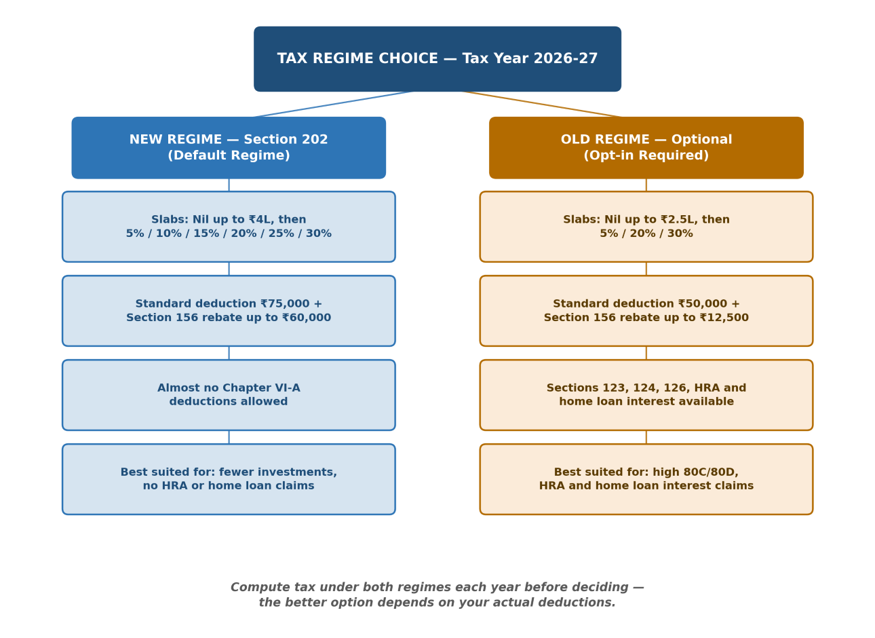
Quick Reference: how the new and old tax regimes branch out under the Income Tax Act 2025
How Does the Section 156 Rebate Make Income Up to ₹12 Lakh Tax-Free?
Section 156 corresponds to Section 87A of the 1961 Act and provides a rebate against tax payable, rather than a deduction from income. Under the new regime, a resident individual whose total income does not exceed ₹12,00,000 gets a rebate of up to ₹60,000, enough to bring tax on that income down to nil. For salaried individuals, the ₹75,000 standard deduction sits on top, so gross salary up to roughly ₹12,75,000 can work out to zero tax, with marginal relief smoothing the transition just above that level. Under the old regime, the Section 156 rebate is capped at ₹12,500 and applies only where total income does not exceed ₹5,00,000.
|
Worked Example Priya has a gross salary of ₹12,50,000 for Tax Year 2026-27 and no other income. Under the new regime, her income after the ₹75,000 standard deduction is ₹11,75,000 — below the ₹12,00,000 threshold — so the Section 156 rebate wipes out her entire tax liability and she pays nil tax. Under the old regime, the same salary, even after a ₹1.5 lakh Section 123 deduction and a ₹50,000 Section 126 deduction, would still attract tax at the 20% and 30% slabs, resulting in materially higher tax. |
New Regime vs Old Regime: Side-by-Side Comparison for Tax Year 2026-27
|
Feature |
New Regime (Section 202) |
Old Regime (Optional) |
|
Basic exemption limit |
₹4,00,000 (all ages) |
₹2,50,000 (₹3L for seniors, ₹5L for super seniors) |
|
Highest slab rate |
30% above ₹24,00,000 |
30% above ₹10,00,000 |
|
Standard deduction (salary) |
₹75,000 |
₹50,000 |
|
Section 156 rebate ceiling |
Up to ₹60,000 (income up to ₹12L) |
Up to ₹12,500 (income up to ₹5L) |
|
Section 123 (80C) deduction |
Not available |
Available up to ₹1,50,000 |
|
Section 126 (80D) deduction |
Not available |
Available up to ₹25,000 / ₹50,000 |
|
HRA exemption |
Not available |
Available |
|
Home loan interest (self-occupied) |
Not available |
Available up to ₹2,00,000 |
|
Employer NPS contribution |
Available |
Available |
|
Default status |
Default from FY 2023-24 onwards |
Requires an active opt-in each year |
How Should a Salaried Individual Decide Between the Two Regimes?
The practical test is simple: compute tax payable under both regimes using actual income and eligible deductions, and pick whichever leaves a lower tax outgo. As a broad rule of thumb, taxpayers whose combined HRA, Section 123, Section 126, and home loan interest claims fall below roughly ₹4–4.5 lakh tend to be better off under the new regime, since its lower slabs and higher rebate outweigh the lost deductions. Taxpayers with larger claims — particularly those repaying a home loan on a self-occupied property while also maxing out Section 123 — often still come out ahead under the old regime.
A Quick Decision Flow for Choosing Your Regime
The flowchart below summarises the decision process most salaried taxpayers can follow for Tax Year 2026-27.
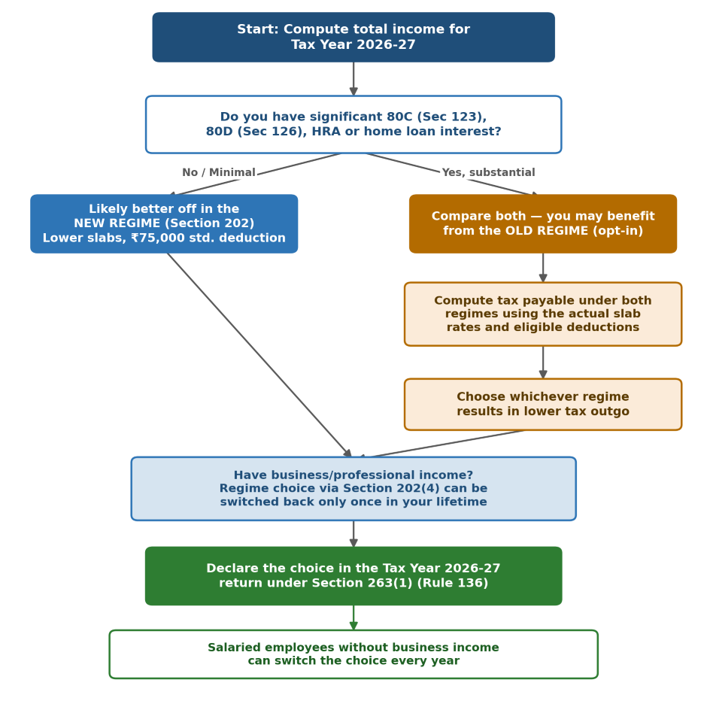
Decision flow: choosing between the new and old tax regimes
Who Should Still Consider the Old Regime?
• Taxpayers with a home loan on a self-occupied property claiming the full ₹2,00,000 interest deduction.
• Taxpayers who receive HRA and pay significant rent in a metro city.
• Taxpayers investing close to the ₹1,50,000 Section 123 limit and also claiming Section 126 for family health insurance.
• Senior and super-senior citizens who benefit from the higher ₹3,00,000 / ₹5,00,000 basic exemption not available under the new regime.
How and When Do You Exercise the Regime Choice for Tax Year 2026-27?
Unlike the earlier Form 10-IEA process under the 1961 Act, Rule 136 of the Income Tax Rules 2026 provides that the option to opt out of, or revert to, the new regime under Section 202(4) is exercised directly in the return of income filed under Section 263(1) — no separate standalone form is prescribed. Salaried taxpayers without business or professional income can make this choice afresh every year, while those with business or professional income face a stricter rule: once they opt out and later return to the new regime, they generally cannot opt out again while that income continues.
What Are the Common Mistakes Taxpayers Make While Choosing a Regime?
• Assuming the regime chosen last year automatically continues — salaried taxpayers must actively re-confirm their choice each year.
• Comparing regimes using only the standard deduction and ignoring HRA, home loan interest, and Section 123/126 claims that change the old regime’s advantage.
• Assuming the ₹12 lakh Section 156 threshold applies to income taxed at special rates, such as capital gains, where the rebate generally does not extend.
• Forgetting that business or professional income taxpayers face restrictions on switching back to the old regime more than once.
Frequently Asked Questions
Is the new tax regime compulsory for Tax Year 2026-27?
No. Section 202 is only the default option. Salaried individuals without business income can choose the old regime every year while filing their return, and switch back the following year if it suits them better.
What replaced Section 115BAC in the Income Tax Act 2025?
Section 202 corresponds to Section 115BAC of the 1961 Act and governs the new tax regime, including its slab rates and opt-out conditions.
Is income up to ₹12 lakh really tax-free under the new regime?
Yes, for a resident individual whose total income does not exceed ₹12 lakh, the Section 156 rebate of up to ₹60,000 brings tax to nil. Salaried taxpayers get a further ₹75,000 standard deduction, extending this to about ₹12.75 lakh, with marginal relief just above that level.
Can I still claim Section 80C and Section 80D under the new regime?
No. Section 123 (formerly 80C) and Section 126 (formerly 80D) are available only under the old regime, with very limited exceptions such as employer NPS contribution under the new regime.
How do I choose the old regime for Tax Year 2026-27?
Under Rule 136 of the Income Tax Rules 2026, the Section 202(4) option is exercised or withdrawn directly in the return filed under Section 263(1), rather than through a separate standalone form.
Are the income tax slab rates different under the Income Tax Act 2025?
No. Budget 2026 made no changes to the slab rates, standard deduction, Section 156 rebate, surcharge, or cess under either regime for Tax Year 2026-27.
Does the old regime still allow HRA and home loan interest deductions?
Yes, both remain available only under the old regime. The new regime does not permit HRA exemption or home loan interest deduction on a self-occupied property.
Conclusion
The move from the Income Tax Act 1961 to the Income Tax Act 2025 has not changed the trade-off between the two regimes — only the section numbers. The new regime under Section 202 still suits taxpayers with limited deductions, particularly salaried individuals earning up to around ₹12.75 lakh, while the old regime remains stronger for anyone with substantial HRA, home loan interest, or Section 123/126 claims. The only reliable way to be sure is to run both computations before filing, rather than defaulting to last year’s choice.
Stay ahead of India’s evolving tax landscape. Visit TaxFlash.in for expert analysis, compliance guides, and the latest updates — curated by tax professionals for tax professionals.
Disclaimer
This article has been prepared by the Taxflash Editorial Team solely for educational and informational purposes. While every effort has been made to ensure the accuracy of the information, readers are advised to refer to the relevant provisions of applicable laws, rules, notifications, circulars, judicial pronouncements, and official government publications before taking any decision. The contents of this article should not be construed as professional legal, tax, or financial advice. Taxflash Editorial Team shall not be responsible for any loss or liability arising from reliance on the information contained herein.
As amended up to the latest publicly available notification or circular at the time of writing.
Author Bio
Total Posts: 15
Comments
No comments yet.
Please login to comment.