
Perks Aren't Free: How Section 17 Taxes Your Accommodation, Car, ESOPs and Loans
Ask any salaried employee what they earn, and they will quote a number from their offer letter. Ask a tax officer the same question, and the answer often runs longer — because a rent-free flat, a chauffeur-driven car, a clutch of ESOPs, or an interest-free loan from the employer all count as income too. These are perquisites, and from Tax Year 2026-27 onwards, they are governed by a freshly renumbered but substantively familiar framework: Section 17 of the Income Tax Act, 2025, read with Rule 15 of the Income Tax Rules, 2026.
For most professionals who cut their teeth on the old Section 17(2) and Rule 3 of the 1962 Rules, the good news is that the underlying logic has not changed dramatically. What has changed is the numbering, a handful of monetary thresholds, and the consolidation of scattered provisions into one tightly structured rule. This piece walks through four of the most frequently encountered — and most frequently miscalculated — perquisites: rent-free accommodation, the company car, ESOPs, and soft loans from the employer, with worked examples, a mind map for each, and a side-by-side comparison against the old regime.
What Counts as a Perquisite Under Section 17?
Section 17(1) of the Income Tax Act, 2025 gives an inclusive — not exhaustive — definition of "perquisite." It covers direct, non-cash benefits such as rent-free housing and ESOPs; indirect benefits, such as the employer settling an obligation that was legally the employee's to pay; and deferred benefits like excess employer contributions to retirement funds. The Supreme Court, interpreting the corresponding provision of the 1961 Act in Arun Kumar v. Union of India (2006 INSC 597), described a perquisite as a privilege, gain, or profit incidental to employment — something the employee receives over and above regular salary or wages, not a mere reimbursement of money the employee had to spend anyway.
The charging framework sits in Sections 15 and 16, while Section 17 supplies the definitions and Rule 15 of the Income Tax Rules, 2026 supplies the arithmetic. Rule 15 is the master valuation rule — it replaced the old Rule 3 of the 1962 Rules — and it covers housing, motor cars, domestic help, utilities, education, ESOPs, loans, gifts, club memberships, and movable assets, all inside a single, table-driven structure.
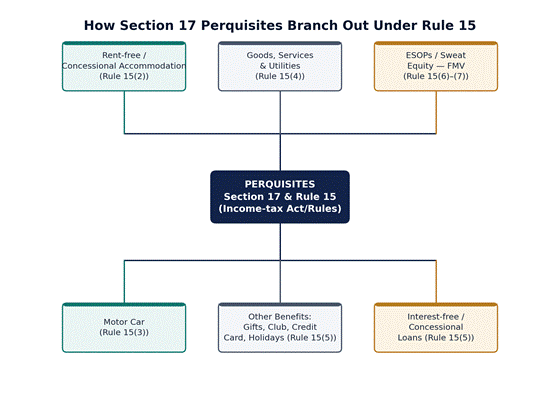
Figure 1: The perquisite universe under Section 17, valued through Rule 15
Who Does This Apply To?
Every employer-employee relationship attracts these provisions, whether the employer is a private company, a partnership, a proprietorship, or the government. Directors, whole-time employees, and — where the rule so specifies — even former employees receiving deferred perquisites fall within scope. The value of a perquisite is added to "Salaries" income and, in most cases, the employer must factor it into monthly TDS under Section 392, so an employee typically sees it reflected well before the return is filed rather than as a year-end surprise.
Rent-Free and Concessional Accommodation: How the Valuation Actually Works
Accommodation is usually the single largest perquisite on a senior employee's payslip, and it is valued differently depending on who the employer is, whether the property is owned or leased, and whether it comes furnished. Under Rule 15(2), a government employer's accommodation is valued at the licence fee fixed by that government, reduced by whatever rent the employee actually pays — a comparatively simple calculation confined largely to public-sector and civil-service employees.
For every other employer, the calculation turns on the city's population as per the 2011 census. Where the employer owns the accommodation, the taxable value is 10% of salary in cities with a population above 40 lakh, 7.5% of salary in cities between 15 and 40 lakh, and 5% of salary everywhere else — in each case reduced by any rent the employee pays. Readers who worked with the pre-2025 law will recognise these exact percentages: the CBDT had already brought Rule 3 down from 15%/10%/7.5% to 10%/7.5%/5% through a 2023 amendment, and Rule 15 simply carries that structure forward. Where the employer takes the property on lease or rent instead of owning it, the value is the lower of the actual lease rent paid or 10% of salary.
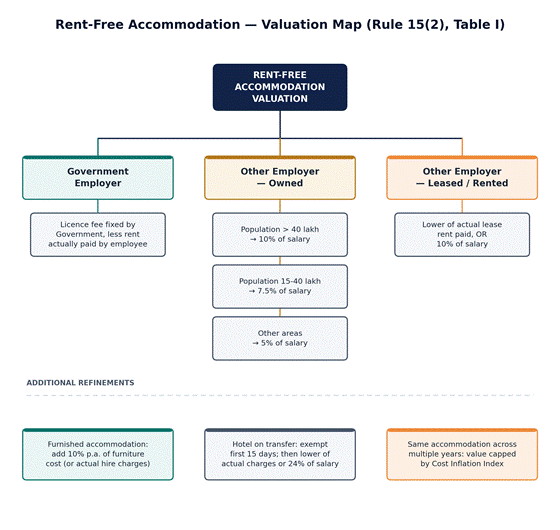
Figure 2: Rent-free accommodation valuation – quick reference
Two refinements are worth flagging. First, if the same accommodation continues to be provided to the same employee across multiple tax years, the valuation for later years is capped with reference to the Cost Inflation Index for the year the accommodation was first provided — this stops the taxable value from creeping up purely because salary has risen, when the employee's actual benefit has not changed. Second, furnished accommodation adds 10% per annum of the cost of the furniture (television, refrigerator, air-conditioning, and similar items) to whatever value applies under the unfurnished table; if the furniture itself is hired, the actual hire charges are added instead. Hotel accommodation provided on a transfer is exempt for the first fifteen days in aggregate; beyond that, it is valued at the lower of actual hotel charges or 24% of salary for the period.
|
Illustration Priya is a manager based in Pune (2011 census population between 15 and 40 lakh) with an annual salary of ₹18,00,000 for perquisite-valuation purposes. Her employer owns the flat she occupies and does not charge her rent. The perquisite value is 7.5% of ₹18,00,000, which comes to ₹1,35,000 for the year. If the flat were furnished with assets costing the employer ₹6,00,000, a further ₹60,000 (10% of ₹6,00,000) would be added, taking the total taxable perquisite to ₹1,95,000. |
Company Car Perquisite: The Numbers Employers Should Recheck
Rule 15(3) values the motor car perquisite based on engine capacity and who bears the running cost, and this is the one area where Rule 15 has moved well beyond a simple renumbering exercise. If the car is used wholly and exclusively for official duties and the employer maintains the prescribed logs, the value is nil. If it is used purely for the employee's personal purposes, the taxable value is the actual running and maintenance expenditure incurred by the employer, increased by notional wear and tear at 10% per annum of the car's cost.
The practically important scenario — a car used partly for work and partly for personal travel, with the employer footing the running cost — now carries flat monthly figures of ₹5,000 for cars up to 1.6 litres (or electric vehicles) and ₹7,000 for cars above 1.6 litres, with a further ₹3,000 a month if the employer also provides a chauffeur. These figures are close to three times the ₹1,800 and ₹2,400 monthly values that applied under the old Rule 3, which had stood largely unrevised for over a decade. Where the employee bears the running cost and only the car itself is provided, the values drop to ₹2,000 and ₹3,000 respectively, again with ₹3,000 added for a driver.
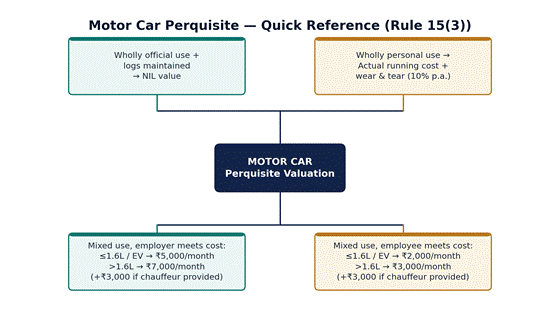
Figure 3: Motor car perquisite — quick reference
Employers running a CTC structure built around car leases should treat this revision as more than a rounding change. Because the notional monthly value — not the actual lease rental — is what gets taxed in the mixed-use scenario, the arbitrage that made employer-arranged car leasing attractive narrows once the notional figures triple. Finance and HR teams should rework CTC templates for FY 2026-27 rather than carry forward last year's numbers.
ESOPs and Sweat Equity: When Does the Tax Actually Bite?
Employee Stock Options move through four stages — grant, vesting, exercise, and sale — but Indian tax law is only concerned with two of them. Neither the grant of an option nor its vesting is a taxable event; the employee has, at that point, merely acquired a right, not an asset. Tax enters the picture at exercise, when the employee actually pays the exercise price and receives shares. Under Rule 15(6) and (7), the perquisite is the difference between the fair market value of the share on the date of exercise and the exercise price paid, multiplied by the number of shares exercised.
Fair market value itself is defined with some precision. For a listed share, it is the average of the opening and closing price on the exercise date on the exchange with the highest trading volume. For an unlisted company's shares — the position most startup employees will encounter — the FMV must be certified by a SEBI-registered Category I merchant banker, and that valuation cannot be more than 180 days old as of the exercise date. This perquisite is added to salary and subjected to TDS under Section 392 in the month of exercise, which is often the first point at which an employee realises that exercising options creates a cash tax outflow even though no shares have been sold.
A second tax event follows at sale: the gain between the sale price and the FMV used at exercise is taxed as a capital gain, not as salary, with the holding period measured from the date of allotment. DPIIT-recognised startups that additionally hold an Inter-Ministerial Board certificate under Section 140 can offer their employees a deferral of the exercise-stage tax, postponing the cash outflow to the earliest of a sale of the shares, cessation of employment, or a prescribed outer time limit. Under Section 392(3), that outer limit is 60 months from the end of the tax year in which the shares are allotted — for shares allotted on or after 1 April 2026, this is an extension from the 48-month window that applied under the corresponding provision, Section 192(1C), of the 1961 Act. It is worth being precise with employees on this point: DPIIT recognition alone, without the separate IMB certificate, does not unlock the deferral — a distinction that catches out a meaningful share of startup finance teams every year.
Interest-Free and Concessional Loans From the Employer
Salary advances, vehicle loans, and personal loans that employers extend at nil or low interest are perquisites under Rule 15(5), Table IV, entry 1. The taxable value is computed by applying the interest rate the State Bank of India charges on loans for the same purpose, as it stood on the first day of the relevant tax year, to the maximum outstanding monthly balance of the loan — and then reducing that figure by whatever interest the employee actually paid. This SBI-rate benchmark is not new; it carries over from Rule 3(7)(i) of the 1962 Rules, and its constitutional validity was tested and upheld by the Supreme Court in May 2024 in All India Bank Officers' Confederation v. The Regional Manager, Central Bank of India & Ors. (2024 INSC 389), where a two-judge bench held that pegging the benchmark to a single, uniform rate promotes certainty and is neither arbitrary nor discriminatory.
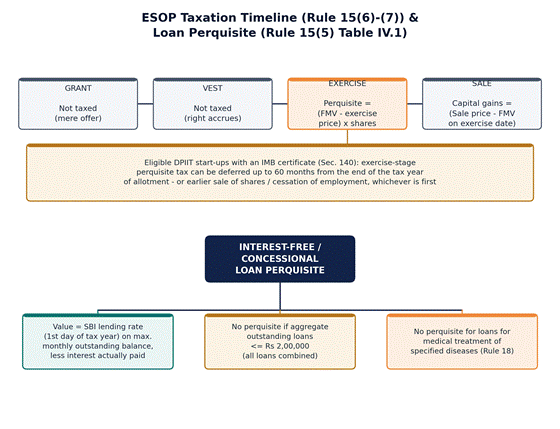
Figure 4: ESOP taxation timeline and loan perquisite valuation
Two exemptions matter in practice. Loans taken for the medical treatment of diseases specified under Rule 18 are not treated as a perquisite at all, unless the amount is later reimbursed under a medical insurance scheme, in which case only the reimbursed portion becomes taxable from the date of reimbursement. Separately, if the aggregate of all loans an employer has extended to an employee does not exceed ₹2,00,000, no perquisite value is computed — a meaningful jump from the ₹20,000 threshold under the old Rule 3(7)(i), and a change that will take a large number of routine salary advances and small personal loans out of the tax net entirely.
|
Illustration An employee has an outstanding personal loan of ₹1,50,000 at 4% interest and a car advance of ₹40,000 at 6% interest from the same employer, taking the aggregate outstanding balance to ₹1,90,000. Because this is below the ₹2,00,000 threshold, no perquisite value is computed on either loan for the year — a result that would not have been possible under the old ₹20,000 ceiling, where the full amount would have attracted a notional interest perquisite. |
Old Rule 3 (1961 Act) vs New Rule 15 (2025 Act): What Actually Changed
The table below sets out the position for the four perquisites covered above, comparing the pre-2026 position under the Income Tax Act, 1961 and Rule 3 of the 1962 Rules with the position from Tax Year 2026-27 under the Income Tax Act, 2025 and Rule 15 of the 2026 Rules.
|
Perquisite |
Old Position (Rule 3, 1962 Rules) |
New Position (Rule 15, 2026 Rules) |
|
Rent-free accommodation (employer-owned) |
10% / 7.5% / 5% of salary by city population (post the August 2023 CBDT amendment) |
Unchanged: 10% / 7.5% / 5% of salary by the same population bands, now codified afresh in Rule 15(2) |
|
Motor car (mixed use, employer bears cost) |
₹1,800/month (≤1.6L) or ₹2,400/month (>1.6L), + ₹900/month for a driver |
₹5,000/month (≤1.6L or EV) or ₹7,000/month (>1.6L), +₹3,000/month for a driver |
|
Interest-free / concessional loan |
SBI rate on max. monthly balance; exempt if aggregate loans ≤ ₹20,000 |
Same SBI-rate method; exemption threshold raised to aggregate loans ≤ ₹2,00,000 |
|
ESOP / sweat equity perquisite |
Taxed at exercise under Section 17(2)(vi); FMV via merchant banker for unlisted shares |
Substantively unchanged under Section 17(1)(d)/Rule 15(6)-(7); same FMV methodology |
|
Governing TDS provision |
Section 192 of the Income Tax Act, 1961 |
Section 392 of the Income Tax Act, 2025 |
|
Salary TDS certificate / return |
Form 16 (certificate) / Form 24Q (quarterly return) |
Form 130 (certificate) / Form 138 (quarterly return) |
What the Courts Have Said
Arun Kumar v. Union of India (2006 INSC 597)
The Supreme Court examined a challenge to the rent-concession perquisite and, in the course of doing so, laid down the working definition of "perquisite" that practitioners still cite today: a privilege, gain, or profit incidental to employment, distinct from a mere reimbursement of an expense the employee would otherwise have borne. The Court also held that Rule 3 (now Rule 15) only operates once a perquisite is shown to exist in the first place — the valuation rule cannot, by itself, manufacture a perquisite where none exists under Section 17.
All India Bank Officers' Confederation v. Central Bank of India & Ors. (2024 INSC 389)
Bank employee associations challenged the SBI-rate benchmark used to value interest-free and concessional loans, arguing that it amounted to excessive delegation of legislative power and treated dissimilar banks as if they were identical. The Supreme Court disagreed on both counts, holding that a single, predictable benchmark reduces litigation and gives both taxpayers and the revenue certainty — values the Court described as hallmarks of good tax legislation. Because Rule 15(5)'s loan-valuation formula is textually identical to the old Rule 3(7)(i), this ruling continues to govern how the SBI-rate mechanism is understood under the new Act.
Compliance: What Employers Must Get Right
TDS on salary, including the perquisite component, now falls under Section 392 of the Income Tax Act, 2025, which succeeds Section 192 of the 1961 Act. Employers estimate an employee's total taxable salary for the year — cash pay plus the value of every perquisite — and deduct tax month by month rather than waiting for the employee to self-assess at year end. The quarterly return has moved from Form 24Q to Form 138, and the salary TDS certificate issued to employees has moved from the familiar Form 16 to Form 130, which now carries a third part (Part C) with a more granular salary computation than the two-part Form 16 provided.
• Recompute CTC structures for FY 2026-27 wherever they include a company car, since the mixed-use notional values have roughly tripled.
• Update payroll software and TAN-linked masters to the Section 392/393 payment-code framework so that quarterly Form 138 filings are not rejected as defective.
• Track the ₹2,00,000 aggregate threshold across every loan an employee holds with the organisation, not loan-by-loan, before deciding whether a perquisite value needs to be computed.
• For ESOP-issuing companies, confirm whether the IMB certificate under Section 140 is actually in place before communicating any deferral benefit to employees — DPIIT recognition by itself is not sufficient.
• Where accommodation is provided across multiple years, apply the Cost Inflation Index cap under Rule 15(2)(d) rather than recomputing the raw percentage every year.
Practical Challenges Employers and Employees Run Into
The most common error is treating the accommodation and car valuation exercise as a one-time payroll setup rather than a figure that needs revisiting whenever salary, city, or usage pattern changes mid-year. A transfer between cities partway through the year, for instance, requires the accommodation perquisite to be apportioned between the old and new locations rather than applied uniformly for the full year.
A second recurring issue is documentation for the "wholly official use" exemption on motor cars — the nil valuation is conditional on the employer actually maintaining logs of the journey, mileage, and purpose, and furnishing a certificate to that effect. Employers that skip this paperwork lose the exemption on audit even where the car genuinely was used only for business purposes.
For ESOPs, the most expensive misunderstanding is assuming that a DPIIT-recognised startup automatically qualifies its employees for the exercise-stage deferral. Only a small fraction of DPIIT-recognised startups additionally hold the IMB certificate, and without it, the perquisite tax falls due in the year of exercise regardless of whether the employee can sell the shares to fund that liability.
Best Practices for Getting Perquisite Valuation Right
• Maintain a perquisite worksheet per employee, updated whenever salary, accommodation, or vehicle arrangements change, rather than relying on a single annual computation.
• Obtain and file the merchant banker's FMV certificate for every ESOP exercise involving unlisted shares, and check that it is dated within 180 days of the exercise date.
• Reconcile Form 130 and Form 138 figures against the payroll register each quarter, since Form 130 can only be generated once Form 138 has been filed and processed on TRACES.
• Where an employee occupies the same accommodation for more than one tax year, apply the Cost Inflation Index cap so the perquisite value does not overstate the benefit.
• Build the aggregate loan-tracking check into the payroll system itself so the ₹2,00,000 exemption threshold is monitored automatically across all loans, not assessed manually at year end.
Frequently Asked Questions
Is Section 17 of the old Income Tax Act, 1961 still relevant?
Only for income and transactions relating to periods up to 31 March 2026. For Tax Year 2026-27 onwards, Section 17 of the Income Tax Act, 2025 and Rule 15 of the Income Tax Rules, 2026 apply, though the substantive concepts carry over closely from the old law.
Has the percentage used to value rent-free accommodation actually changed under the new Act?
No. The 10%/7.5%/5% bands by city population were already introduced through a 2023 CBDT amendment to the old Rule 3, and Rule 15 simply continues the same structure rather than revising it further.
Why has the company car perquisite value increased so sharply?
The flat monthly figures under the old Rule 3 — ₹1,800 and ₹2,400 — had not been revised in years and no longer reflected running costs. Rule 15 raises these to ₹5,000 and ₹7,000 respectively to better track actual expenses.
Does ESOP taxation change under the new Act?
The substance does not change — tax still arises at exercise on the FMV-minus-exercise-price spread, and again at sale as a capital gain. What has changed is the section numbering and the TDS provision reference, which moves from Section 192 to Section 392.
Is every employer loan to an employee taxable as a perquisite?
No. Loans for the medical treatment of specified diseases are excluded, and loans whose aggregate outstanding balance across the employer relationship does not exceed ₹2,00,000 are not treated as a perquisite at all.
Who values ESOP shares of an unlisted company for perquisite purposes?
A SEBI-registered Category I merchant banker must certify the fair market value as on the date of exercise, or an earlier date not more than 180 days before exercise.
Does the employee have any TDS obligation on perquisites, or is it entirely the employer's responsibility?
The obligation to deduct and deposit TDS under Section 392 rests with the employer. The employee's responsibility is to furnish accurate declarations of other income and investments so the employer's TDS estimate for the year is realistic, and to reconcile the final Form 130 against Form 26AS/Form 168 before filing the return.
Conclusion
The move from the Income Tax Act, 1961 to the Income Tax Act, 2025 has not rewritten the economics of perquisite taxation so much as it has renumbered, consolidated, and — in a few specific areas like the motor car and the loan-exemption threshold — recalibrated it. Employers who treat this purely as a search-and-replace exercise on section numbers risk under- or over-deducting TDS through the transition, while employees who assume nothing has changed risk misjudging their in-hand pay. The safer approach is the one this guide has tried to model: work through each perquisite on its own facts, check the current Rule 15 valuation method against the specific circumstances, and keep the underlying documentation — logs, certificates, and rent receipts — that any valuation ultimately depends on.
Have questions about how a specific perquisite applies to your organisation? Explore more in-depth guides and expert commentary at TaxFlash.in.
Disclaimer
This article has been prepared by the Taxflash Editorial Team solely for educational and informational purposes. While every effort has been made to ensure the accuracy of the information, readers are advised to refer to the relevant provisions of applicable laws, rules, notifications, circulars, judicial pronouncements, and official government publications before taking any decision. The contents of this article should not be construed as professional legal, tax, or financial advice. Taxflash Editorial Team shall not be responsible for any loss or liability arising from reliance on the information contained herein.
As amended up to the latest publicly available notification/circular at the time of writing. Some provisions of the Income Tax Act, 2025 and the Income Tax Rules, 2026 have been reported with inconsistent detail across secondary commentary during this transition period; readers relying on any specific figure for a filing decision should cross-check it against the Gazette text or a current professional source.
Author Bio

Total Posts: 15
Comments
No comments yet.
Please login to comment.